
Fitz Hugh Ludlow: The Visionary of College Hill
His Time on the Heaven-Kissing Hill and His Enduring Legacy
Fitz Hugh Ludlow (1836–1870) was born into the fire of abolition. Months before his birth, a pro-slavery mob stormed his parents’ New York City home so violently that Fitz later wrote the family found their parlor filled with paving stones, their belongings slashed and burned, and the word “ABOLITIONIST” scorched into the soot of the walls. His father, Rev. Henry G. Ludlow, refused to retreat. By the time Fitz was a child, Reverend Ludlow was both a pastor and an active “ticket puncher” on the Underground Railroad—work young Fitz witnessed through coded language, whispered warnings, and nighttime vigilance.
This was the world that formed him.
Arrival at Poughkeepsie and the Heaven-Kissing Hill
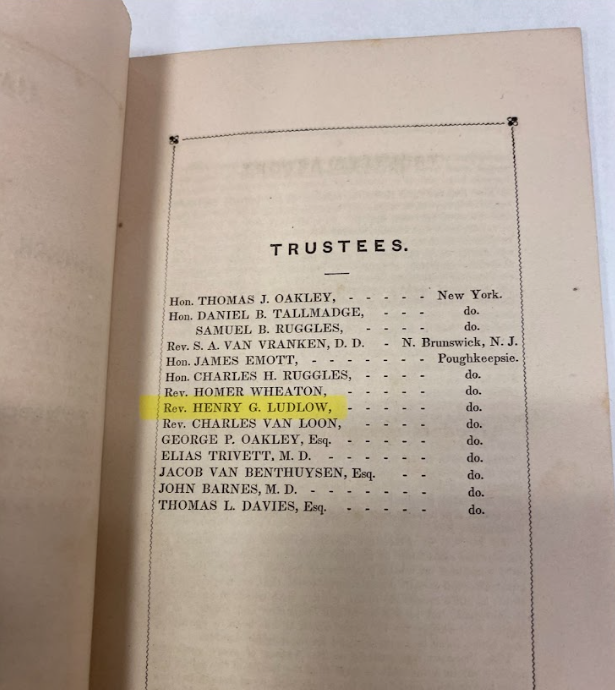
In the mid-1840s, the Ludlows moved to Poughkeepsie, where Reverend Ludlow became a trustee of the Poughkeepsie Collegiate School atop College Hill—an institution long rumored to be a quiet stronghold of Underground Railroad activity. Its Christian faculty, moral seriousness, and culture of abolitionist conviction made the school a natural extension of the Ludlow family’s mission.
It was here that Fitz Hugh Ludlow enrolled, learned, and wrote.
The Hasheesh Eater and its Prophetic Visions
In 1857, Ludlow published The Hasheesh Eater, a memoir of visionary intensity. Behind its literary daring rests a soul shaped by Scripture, morality, and the realities of abolitionist struggle.
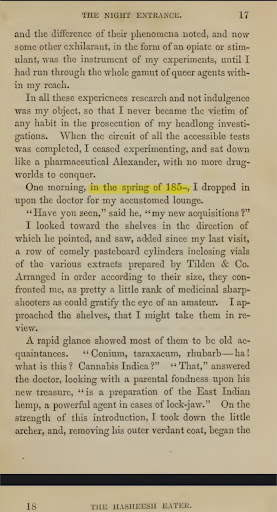
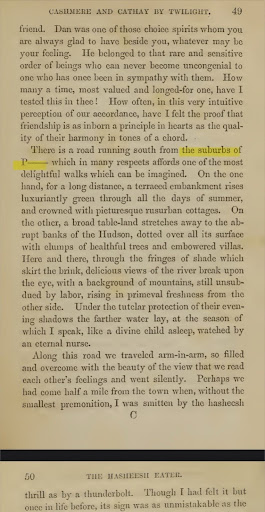
One of the most intriguing features of the memoir is Ludlow’s deliberate concealment of when and where his earliest visionary experiences began. When describing the year he first visited a doctor to obtain Cannabis Indica, he leaves the date incomplete—“185–”—and gives the city only as “P———.”
This omission is striking, because The College Hill Mercury confirms that Ludlow was already in Poughkeepsie in 1850, serving as editor of the paper’s ninth edition. The clues align naturally: a city beginning with P, an unspecified year in the early 1850s, and a young writer surrounded by secrecy, moral tension, and abolitionist networks.
“The Night Entrance” — A Telling Title
Further deepening the mystery, the very first chapter of The Hasheesh Eater is titled “The Night Entrance.”
The phrase implies an entryway accessible only in darkness, a threshold that opens under moonlight. Symbolically—and perhaps literally—it evokes the kind of secret passage used in abolitionist strongholds: quiet, hidden, and known only to those entrusted with its purpose.
For a student living on College Hill—a place long rumored to contain hidden rooms, concealed corridors, and nighttime routes used for Underground Railroad activity—the title reads less like literary flourish and more like a veiled reference to a real entrance, one that opened only at night and led into the hill’s concealed interior.
Whether Ludlow meant to gesture toward an actual passageway or a spiritual threshold, the image harmonizes perfectly with the secrecy surrounding “P———” and “185–,” suggesting that his earliest experiences began in a place of shadows, silence, and hidden work.
Visions Beyond His Century
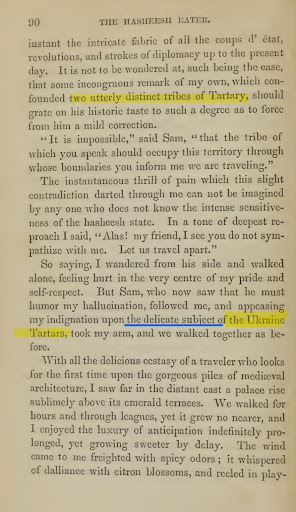
Within the memoir, Ludlow recounts a dramatic vision of a battlefield filled with “Ukraine Tartars,” a persecuted people whose suffering in the 19th century echoes eerily into the present day. His imagery of exile, devastation, and human anguish possesses an uncanny clarity, as though he touched a current of suffering that stretched beyond his own age.
Whether the vision was prophetic or born of a spiritually heightened imagination, Ludlow perceived truths his century was not prepared to hear.
A Voice of Brotherhood and Divine Justice
Ludlow’s commitment to abolition extended beyond metaphor. In If Massa Put a Gun in Our Hands, he records one of the most moving exchanges in American literature: a grieving enslaved man crying out, “Lord’s time! Oh, is der any Lord?”
Ludlow’s answer was not philosophical—it was brotherhood.
A single word, spoken across centuries of suffering.
It moved the man to reply with trembling resolve:
“Den I will try for to bide de Lord’s time.”
This moment reveals Ludlow’s deepest conviction:
that God’s justice moves slowly, but with unstoppable purpose.
Final Years and Lasting Echoes
Ludlow died young, at only thirty-four. Yet his writings—spanning memoir, fiction, social critique, and abolitionist testimony—remain powerful windows into the soul of a man raised between Scripture and struggle.
For those restoring The College Hill Mercury today, Ludlow is far more than a teenage editor or literary experimenter.
He is a visionary shaped by moral storms, a writer whose coded wit, spiritual intensity, and fierce compassion still speak with clarity.
On the Heaven-kissing hill above the Hudson, his voice was born.
In a fractured age longing for truth, his voice returns.
© 2026 Michael J. Bentley. All rights reserved.
The College Hill Mercury project, including its transcription, commentary, annotations, interpretations, essays, website text, research, arrangement, and presentation, is the copyrighted work of Michael J. Bentley. No portion of this website, manuscript, or original scholarship may be copied, reproduced, distributed, republished, adapted, or used for commercial purposes without written permission, except as permitted by law.