
The Contributions of Fredrick Douglass
His Escape, His Voice, and His Mysterious Ties to College Hill
Frederick Douglass (1818–1895) was born enslaved in Talbot County, Maryland, without a birthday, a surname he could call his own, or a future he was permitted to imagine. And yet—by God’s providence—his path would lead him to become one of the greatest orators, writers, and moral forces in human history.
From Secret Letters to the Road of Freedom
Even as a child, Douglass understood that education was the path out of bondage. Sophia Auld, the wife of his Baltimore enslaver, first taught him the alphabet. Though slavery soon hardened her heart and forbade her kindness, the spark she lit in Douglass ignited a lifelong flame. He secretly continued learning, believing—long before the nation recognized it—that literacy was liberation.
In 1838, at about twenty years old, Douglass made a daring escape. Disguised as a sailor and using borrowed free papers, he traveled north by train and steamboat until he reached New York City. There he found refuge with the great Black abolitionist David Ruggles, an Underground Railroad conductor who sheltered Douglass and guided him toward freedom.
Douglass later wrote of this moment:
“I felt as one might feel upon escape from a den of hungry lions…
Anguish and grief may be depicted; but gladness and joy, like the rainbow, defy the skill of pen or pencil.”
Some wonder today whether this letter—addressed vaguely to “a friend”—may have been an early communication connected to College Hill, whose founder Charles Bartlett died nearly two decades later with secrets he never put to paper. Even Douglass’s silence about certain early travels raises the possibility that he protected individuals involved in abolitionist education and the Underground Railroad well into Reconstruction.
A New Name, A New Life
From New York, Ruggles sent Douglass and his fiancée Anna to New Bedford, Massachusetts, where they were welcomed into the home of Nathan and Mary “Polly” Johnson—members of the free Black community and active abolitionists. The Johnsons even paid the couple’s stagecoach fare when Douglass could not.
It was Nathan Johnson who suggested the surname “Douglass,” taken from Sir Walter Scott’s The Lady of the Lake.
Thus Frederick Bailey became Frederick Douglass, the name the world would come to revere.
In New Bedford, Douglass wrote of his first peace in freedom:
“We now began to feel a degree of safety, and to prepare ourselves for the duties and responsibilities of a life of freedom.”
His responsibilities, however, would soon grow beyond anything he could have foreseen.
Was Frederick Douglass Educated at College Hill?
The Quiet Mystery Beneath the Heaven-Kissing Hill
Though Douglass was famously self-taught, traces of local lore and circumstantial evidence suggest that Poughkeepsie’s College Hill may have played a hidden role in shaping his intellectual rise.
Clue 1: The 1847 Poughkeepsie Visit He Never Recorded
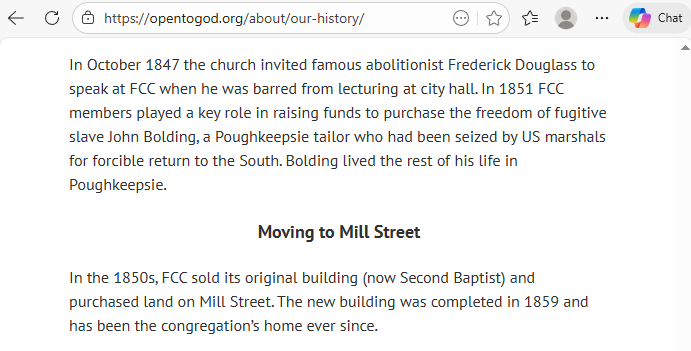
Historical whispers claim that in 1847, Douglass—barred from speaking at Poughkeepsie City Hall—spoke instead at the First Congregational Church. Oddly, he never mentioned this event in any of his autobiographies.
Why would Douglass, whose memory was meticulous, omit such a defining visit?
Clue 2: The Silence Before Bartlett’s Death
Douglass only publicly returned to Poughkeepsie after Charles Bartlett’s passing in 1857. If College Hill was a known abolitionist hub, Douglass may have kept earlier ties secret to avoid exposing Bartlett or any freedom-seeking students sheltering on the hill.
Clue 3: The Mysterious Author “Automath” in The Mercury
The Mercury contains writings by an author signing as “Automath”—literally meaning self-taught.
The style is powerful, moral, and unmistakably reminiscent of Douglass.
Was this a hidden contribution?
A training ground for The North Star?
A coded participation in the intellectual life of College Hill?
No one can yet say for certain—but the possibility is striking.
Clue 4: The “Polly Room on Broadway”
Another Mercury writer, Mrs. Partington, described an Underground Railroad meeting space called the “Polly Room.”
Polly Johnson—Douglass’s first host in freedom—was one of his earliest protectors.
Was the name simply a joke?
Or a hidden signal that Douglass himself had been sheltered, taught, or quietly present at College Hill?
The Mercury’s humor often used camouflage. This reference, too precise to dismiss, may be one more piece of a larger tapestry.
A Final Question
If Douglass did indeed spend time at College Hill in the 1840s, it would help explain:
his early mastery of rhetoric
his confidence in starting The North Star
his ties to New York’s abolitionist networks
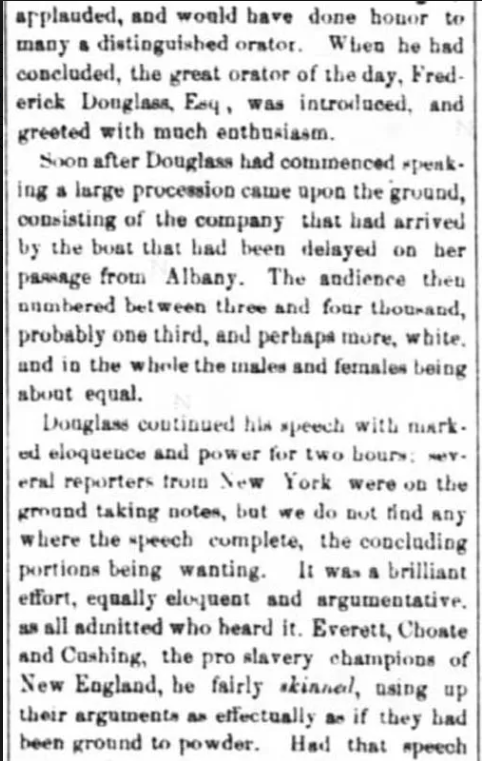
and his triumphant 1858 address on the West Grove, delivered before thousands
Nothing definitive can yet be proven.
But the clues—subtle, recurring, and spiritually resonant—invite fresh examination of Douglass’s path to greatness.
The Legacy of Frederick Douglass
Frederick Douglass devoted his entire life to the expansion of liberty in America. After escaping slavery, he became:
a national orator,
a pioneering journalist,
the publisher of The North Star,
a bestselling autobiographer,
an advisor to presidents, and
a champion of universal human rights.
He stood boldly for women’s suffrage at the Seneca Falls Convention in 1848, decades before such ideas were socially acceptable. His speeches shook the conscience of a nation. His writings opened eyes across the world.
Yet even in his triumph, he carried the weight of secrecy born from the Underground Railroad.
For that reason, the possibility that he studied privately—or found refuge—at College Hill cannot easily be dismissed.
What is certain is this:
Frederick Douglass’s voice still echoes across the Heaven-kissing hill.
His courage still guides our moral imagination.
And whether he ever walked College Hill’s corridors in secret or only stood upon its West Grove in glory, his legacy and the school’s mission remain intertwined—both dedicated to the freedom of the oppressed and the illumination of truth.
May his life continue to inspire all who read The College Hill Mercury and all who seek the light of justice in their own time.
© 2026 Michael J. Bentley. All rights reserved.
The College Hill Mercury project, including its transcription, commentary, annotations, interpretations, essays, website text, research, arrangement, and presentation, is the copyrighted work of Michael J. Bentley. No portion of this website, manuscript, or original scholarship may be copied, reproduced, distributed, republished, adapted, or used for commercial purposes without written permission, except as permitted by law.